Battery Pack Aadhaar System

Empowering India’s Electric Revolution: Battery Pack Aadhaar System

As the global landscape shifts toward digitalization and electrification, energy storage serves as the cornerstone for efficient and flexible power delivery. Within this transition, batteries, particularly lithium-ion variants, have emerged as the primary energy source for the growing electric vehicle (EV) market. India is rapidly advancing its efforts to become a leader in the clean mobility revolution through targeted research and innovation. However, the rapid expansion of this sector brings significant environmental challenges regarding battery disposal, raw material depletion, and end-of-life treatment.

To address these complexities, the Office of the Principal Scientific Advisor (PSA) to the Government of India has identified this initiative as a priority project. The implementation is structured under the Centre of Excellence for Zero Emission Trucking (CoEZET) framework in partnership with the Automotive Research Association of India (ARAI). Furthermore, the Ministry of Road Transport & Highways (MoRTH) has formed a technical committee that has successfully verified the feasibility of the Battery Aadhaar system and released the official draft. This indigenous initiative is designed to ensure end-to-end traceability and foster a sustainable circular economy within the Indian battery ecosystem.

The Core Objective: A Digital Identity for Every Battery

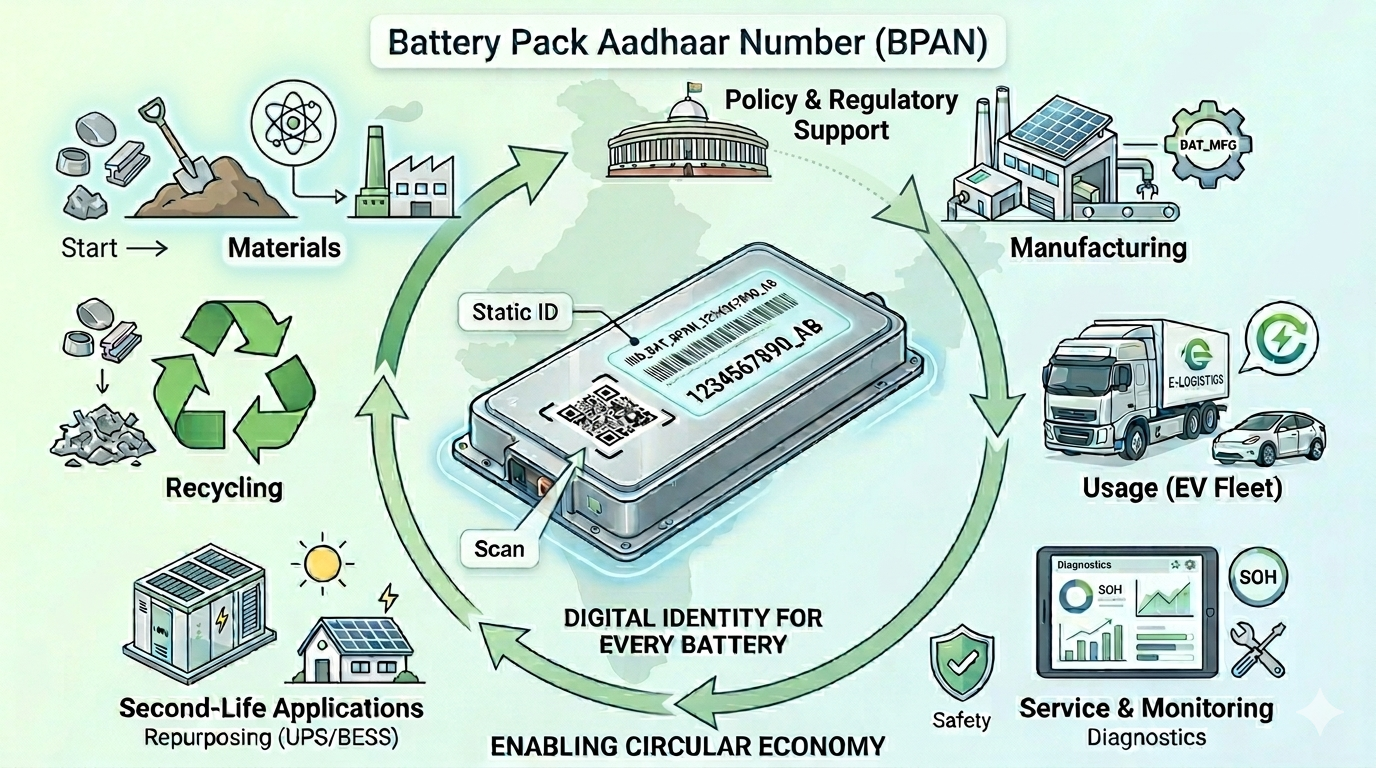
The Battery Pack Aadhaar is a digital identification and data storage system that tracks a battery throughout its lifecycle, from raw material extraction and manufacturing, to usage, second-life application, and final disposal. It serves as a "common digital spine" that allows various regulatory frameworks, such as Extended Producer Responsibility (EPR) and Battery Waste Management (BWM) rules, to reference a single, standardized record. This system aims to bring unprecedented transparency and accountability to the industry, helping stakeholders verify performance, environmental impact, and domestic value addition.

Battery Aadhaar System

Technical Framework and Methodology

The system ensures data remains accessible, secure, and useful across different stages of a battery’s life.

Alphanumeric Code (Static / Public)

Each battery pack is assigned a unique 21-character Battery Pack Aadhaar Number (BPAN). This code is physically affixed to the battery for offline identification.

QR Code (Static / Public)

A QR code linked to the BPAN provides deeper technical details such as material composition and carbon footprint parameters.

Server-based Data (Dynamic / Private)

This layer captures real-time operational history, State of Health (SOH), and safety incidents with restricted access.

Key Information Segments

The data stored within the Battery Pack Aadhaar is systematically organized into six essential categories

icon

Battery Manufacturer Identifier (BMI)

Uniquely identifies the country and the manufacturer.

icon

Battery Descriptor Section (BDS)

Summarizes technical specifications like capacity, chemistry, and nominal voltage.

icon

Battery Dynamic Data (BDD)

Acts as a "living record" by tracking evolving parameters like State of Health (SOH), usage patterns, and safety incidents. This sensitive, server-based data is restricted to authorized entities to support real-time diagnostics and second-life assessments.

icon

Battery Identifier (BI)

Encodes the specific manufacturing date, factory code, and sequential production number.

icon

Battery Material Composition (BMCS)

Details the materials used in the anode, cathode, and electrolyte, along with recyclability percentages.

icon

Battery Carbon Footprint (BCF)

Declares the greenhouse gas impact across the battery’s lifecycle stages.

A Collaborative Ecosystem

The success of the Battery Pack Aadhaar relies on a diverse group of stakeholders. Cell manufacturers, battery manufacturers, and importers are responsible for assigning the BPAN and uploading initial data. Vehicle OEMs are tasked with recording these identifiers in national databases like VAHAN. Authorized Centres should update the SOH data where it can be assessed. In case of any incidents, the dynamic data should be updated by authorized personnel. Once the battery moves to a second life application like UPS, Inverter, Battery Electric Storage System (BESS), etc, authorized personnel should update the dynamic data. Finally, recyclers and waste management operators close the loop by recording the outcomes of material recovery.

Summary

The Battery Pack Aadhaar System represents a lean, scalable, and future-ready digital backbone for India’s energy transition. By ensuring that every battery has a verifiable digital identity, India is not only tackling environmental challenges but also building a robust infrastructure for sustainable mobility. This system ensures that as the nation moves toward a greener future, it does so with transparency, safety, and a commitment to a truly circular economy.

Frequently Asked Questions

Battery Pack Aadhaar is a standardized digital framework tracking electric vehicle batteries across their entire lifecycle. Functioning as a shared digital spine, it traces batteries from raw material sourcing and production through on-road use, second-life repurposing, and final recycling. Helping Indian regulators and manufacturers verify battery safety, performance, and environmental compliance.

Each registered EV battery pack receives a unique 21-character alphanumeric Battery Pack Aadhaar Number (BPAN) and a static QR code displaying public specifications like material composition and carbon footprint. Sensitive, real-time performance and safety logs are stored securely in a restricted, server-based dynamic database.

To ensure comprehensive tracking, the data is organized into six essential information segments:

  • Battery Manufacturer Identifier (BMI):Pinpoints the manufacturer and country of origin.

  • Battery Descriptor Section (BDS): Summarizes core technical specifications like nominal voltage, chemistry, and battery capacity.

  • Battery Identifier (BI): Encodes the production factory code, exact manufacturing date, and serial number.

  • Battery Material Composition (BMCS): Details the chemical makeup of the anode, cathode, and electrolyte, as well as the battery's recyclability percentage.

  • Battery Carbon Footprint (BCF): Declares the environmental greenhouse gas impact across all lifecycle stages.

  • Battery Dynamic Data (BDD): A secure, restricted database that logs real-time operational metrics, including safety incidents, usage history, and the battery's evolving State of Health (SOH).

Yes. By tracking a battery’s State of Health (SOH) and usage history online, authorized centers can assess if retired EV batteries are safe for a second life in stationary storage (BESS, Inverters, UPS). When fully degraded, recyclers log material recovery data to ensure a closed-loop circular economy.

The framework is a collaborative ecosystem with defined responsibilities for different players:

  • Cell & Battery Manufacturers/Importers: Will generate the unique BPAN and input the initial manufacturing, material, and specifications data.

  • Vehicle OEMs (Original Equipment Manufacturers): Will link and log the battery identifiers directly within India's national vehicle registry, VAHAN.

  • Authorized Service & Testing Centres: Regularly update on-road operational parameters, safety incidents, and State of Health (SOH) evaluations.

  • Recyclers & Waste Management Operators: Will close the loop by registering the final material recovery and recycling outcomes once the battery is discarded.