
Gujarat

Chhattisgarh

Bihar

Jharkhand

Madhya Pradesh

Karnataka

Kerala

Tamil Nadu

Maharashtra

Telangana

Andhra Pradesh
Every major revolution begins with a simple conversation. We believe that transformative change happens when you engage with people in their own environments, using the language they speak. This foundational belief sparked an outreach initiative designed to ignite progress from deep within India's trucking ecosystem. Rather than just discussing policy in boardrooms, we took the ZET mission to the ground level. By engaging the community at bustling highway pitstops and logistics hubs, we connected directly with the heartbeat of the nation’s transport sector.
Gujarat
Chhattisgarh
Bihar
Jharkhand
Madhya Pradesh
Karnataka
Kerala
Tamil Nadu
Maharashtra
Telangana
Andhra Pradesh
In just twelve months of dedicated outreach, the initiative has evolved from a grassroots concept into a powerful nationwide movement. We recognized early on that for a revolution to take root, it must move beyond the boardroom and into the heart of the industry. To achieve this, our teams traveled extensively across 13 states and 55 districts, ensuring that the message of zero-emission trucking reached the country’s most vital logistics corridors. By hosting over 200 dedicated outreach events, we were able to facilitate direct, face-to-face engagements with more than 4,000 key stakeholders, including the drivers, fleet owners, and mechanics who serve as the backbone of India’s transport sector.
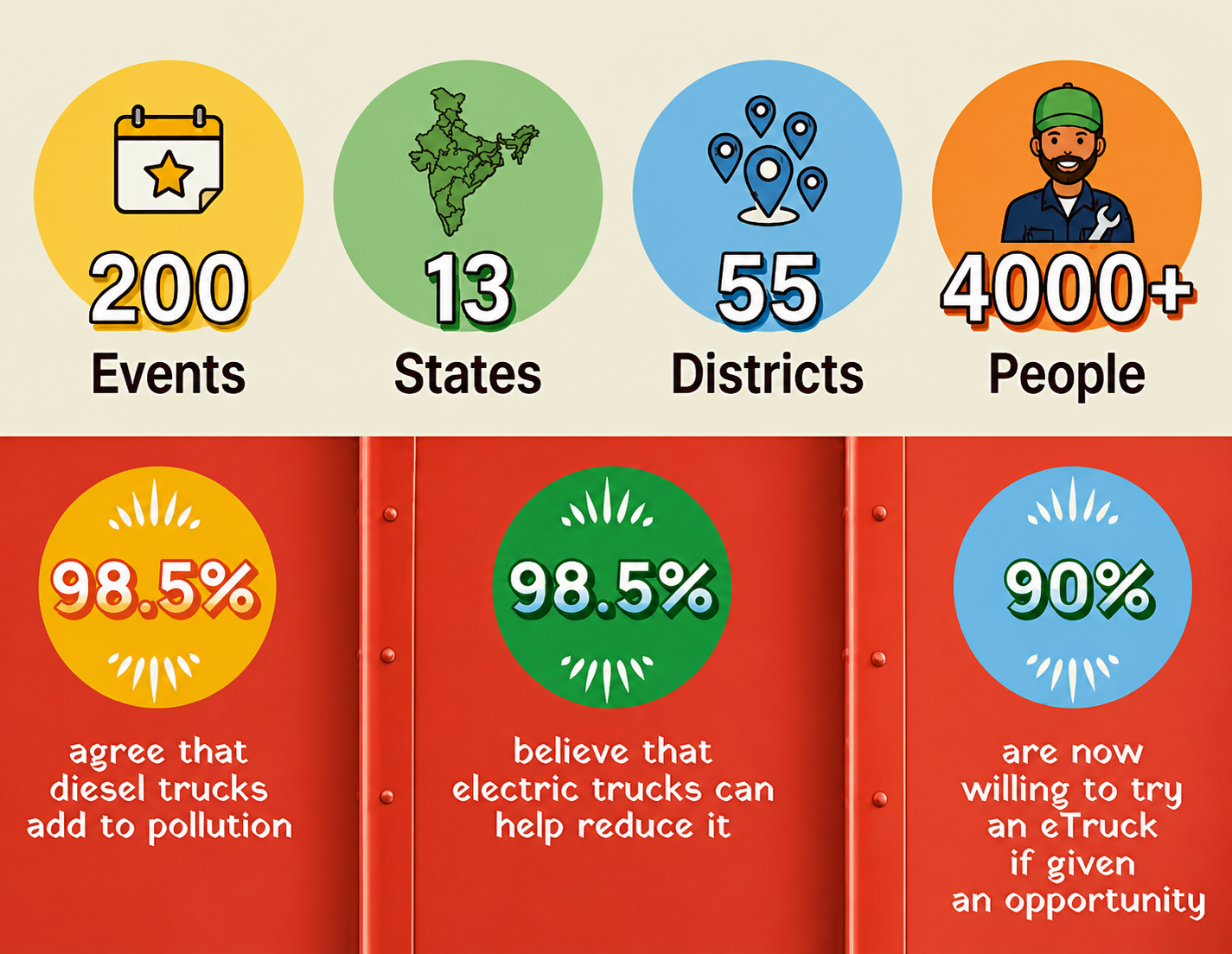
This extensive physical presence allowed us to gather critical insights into the shifting mindsets of those on the front lines. The data we collected reveals a profound awakening within the community regarding environmental responsibility. An overwhelming 98.5% of the individuals we engaged now agree that traditional diesel trucks are a primary contributor to rising pollution levels. More importantly, this awareness is coupled with a strong sense of optimism; an equal 98.5% of participants expressed a firm belief that electric trucks are a viable and necessary solution to mitigate this environmental damage. This shift represents a fundamental change in how the industry views its own role in India’s sustainable future.
The most encouraging takeaway from this year-long journey is the tangible readiness for adoption that we witnessed across every hub. Beyond simply acknowledging the technology, the workforce is eager for hands-on experience. Our findings show that 90% of stakeholders are now willing to operate or transition to an e-Truck if given the opportunity. This high level of readiness proves that the perceived barriers to electrification, such as skepticism regarding performance or reliability, are rapidly dissolving. By meeting the industry where they live and work, we have not only raised awareness but have also cultivated a genuine appetite for the zero-emission revolution.
Achieving a nationwide transition to zero-emission transportation requires the active buy-in of the entire value chain, and our data confirms that the industry is not just ready, it is eager to lead this shift. For fleet operators, the business case for electrification has become increasingly clear as the operational logic of electric trucks moves from theory to practice. Currently, 75% of freight operators view e-trucks as a highly feasible alternative to diesel, and this confidence is translating into action, with 60% already integrating electric vehicles into their future business roadmaps. This reflects a key strategic insight: decision-makers now recognize that zero-emission trucking is not just an environmental mandate but a path toward long-term profitability.
Similarly, the vital maintenance backbone of the industry is preparing for a technological evolution. Mechanics across the country are showing a profound commitment to future- proofing their skills, with 96% expressing a proactive desire to upskill and master the technical requirements of next-generation electric powertrains. This collective readiness from the operators managing the fleets to the skilled professionals maintaining them demonstrates that the entire ecosystem is prepared to support and sustain the electric revolution on Indian roads.
India’s transport sector is the fastest-growing source of carbon emissions, with road transport responsible for the majority of energy use and emissions. Within this sector, commercial trucking contributes nearly one-third of transport-related CO₂ emissions, making freight electrification, particularly in the medium and heavy-duty segments, critical amid rapid urbanisation and the growth of e-commerce.
View pdfFrom forward-thinking mechanics in small-town workshops to environmentally conscious drivers at highway pitstops, the Indian trucking ecosystem is no longer just observing the electric revolution; it is ready to lead it. Our mission at CoEZET continues to bridge the gap between high-level policy and ground-level practice. By bringing Zero-Emission Trucking (ZET) awareness directly to the transport hubs, fuel stations, and workshops where India’s economy finds its momentum, we are ensuring that the transition to sustainable freight is inclusive, informed, and unstoppable. As we look toward the future, the data is clear: the appetite for change is immense. We are moving beyond the phase of "if" and into the era of "how". By continuing to foster these direct connections, providing the necessary technical upskilling, and supporting fleet operators in their strategic shifts, we are collectively steering the nation toward a cleaner, efficient, and more resilient transport sector.
